Embrace The Darkess
Answers provided by: Stephen Stott (he/him), Founder of Embrace The DarknessSome people build businesses. Others build spaces that help people survive, heal, and finally feel seen. Reading Stephen’s story gave me chills because the first person I told I was gay to also passed away just one week after I told them. There was so much of his journey that deeply resonated with me - the grief, the fear, the visibility, and the long road toward feeling comfortable in your own skin. Embrace The Darkness was born from those lived experiences and from the courage to stop shrinking in spaces that were never fully built for all identities to exist safely within them. Through community, kindness, and radical authenticity, Embrace The Darkness is creating space for people to embrace every part of themselves - especially the parts the world once told them to hide. We’re honored here at Everywhere Is Queer to highlight the human behind this work and the deeply personal journey that led to creating a community rooted in belonging, healing, and connection. Thank you for sharing your story Stephen with the world and hope you all enjoy this interview.
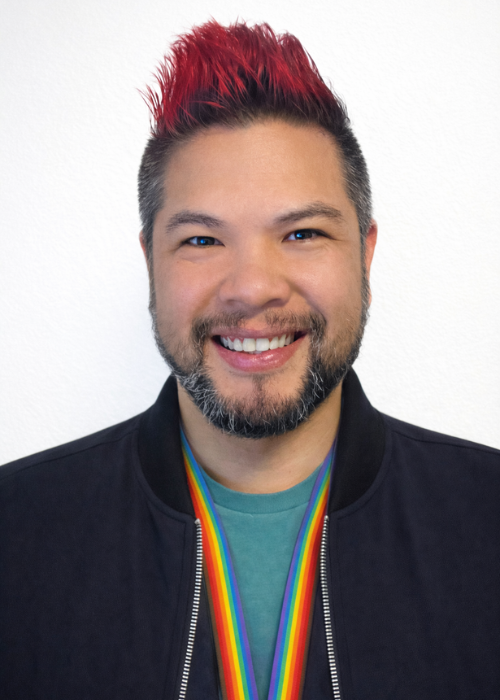
Image provided by Stephen Stott
1. Tell us about your journey. how did your queer-owned business come to life?
The business came to life from burnout. Living life and just going through the motions. Staying quiet and not speaking up because staying quiet kept me safe and liked. But even before starting my business, I started speaking up in different ways whether it was creating visibility where I volunteered or creating visibility where I worked.
Queerness in a lot of spaces is just a box to check or a statement to make. “We are a non-profit and we support everyone,” and I’m sure it makes people feel like they are doing something but it only eases their discomfort while it intensifies ours.
But I showed up. Whether wearing something rainbow themed, having rainbow colored bracelets with tabling at events, mentioning LGBTQ+ when I’m on stages, and even sharing my story around sibling grief.
My sister was the first person I told that I liked boys. I didn’t even say the word gay. We were driving up to Maine because she was teaching a private National Cheerleaders Association cheerleading camp and I was voluntold by our mom to go with her on the 6 hours drive because none of her friends were able to go. On the drive up she said that our mom was concerned about me and it seems our mom made my sister do the dirty work to ask.
Stacy asked if I liked girls, and I said “no.”
She then asked if I liked boys, and I said “yes.”
And that was the end of the conversation. Nothing changed that weekend. We hung out, ate, and she would go to the high school during the day to teach cheerleading over the weekend.
On the long drive back, we had stopped when we were about 45 minutes from home to use the restroom and grab some snacks. Unfortunately, we both fell asleep. I remember the glass shattering but the next thing I remembered after that was waking up in the hospital as a male nurse was putting a warm blanket over me.
In my head, all I could think about was my sister and at the same time I already knew.
My mother came into the hospital room moments later and told me that Stacy had died.
I knew I was different when I was a child and I never knew why. When I got older, I felt my attraction to other boys and it still felt foreign. It is like a battle between something you want and a good feeling mixed with a feeling of shame or something I didn’t deserve.
I grew up with the world telling me there was something wrong with me. I was 13 when Matthew Shepard died, and I was 16 when my sister died when I told her I liked boys three days prior.
And if I’m being honest, I didn’t start to feel comfortable in my own skin until I was around 29. This part includes more grief because if my uncle did not die, I probably would have never met my cousin who is also gay.
He is the eldest surviving child that lived in the United States and another cousin of mine was able to find him so that he could make the decisions about what needed to be done for his father’s services.
The first time we met it was like we were family. Pun intended.
There was a connection without words, an understanding.
Whenever I was in Florida or got the chance to visit I would. We would go to the gay bars and clubs, and just hang out. And then I moved to Florida when I was 29 and we were thick as thieves. We were always together, going out, going to the beach, going to Pride, and killing zombies.
It was the first time that life felt normal. I felt like I belonged. I felt like I found my people, my community.
And this was probably around the same time I started advocating for LGBTQ+ visibility. Where I was working at the time I was able to change my work title to Counseling Coordinator & LGBTQ+ Advocate. As a veteran based non-profit that provided long-term emotional support for those grieving the death of a person who served in the military, they had the mindset that they support everyone and that because Don’t Ask Don’t Tell was repealed that all was well in the world. So I became the visibility that I felt was missing. Something that people could see even if they weren’t out yet whether for the adults, the children and teens, and the veterans and service members who volunteered with the non-profit.
The other nonprofit that I volunteered with had the same mentality that they supported everyone so I again decided to put my action where my mouth was, and when I was on stage speaking to the conference attendees I made a commitment to creating more visibility for the LGBTQ+ community. At the end of the conference, I had two moms approach me to say thank you because no one had ever said LGBTQ+ on the stage. They were long time members and received great support but their marriage probably wasn’t something they mentioned in groups, and there might even be a possibility that they didn’t attend the same group because people would probably figure it out that their child who died had two moms. A part of this is just my thoughts because we never talked about this, and yet these are the experiences we have.
Not knowing if it is safe to be who you are and being careful not to say too much or anything, especially with the way the world is today.
I am queer, I am a surviving sibling, I am the son of a man who came to the US as a refugee, I was raised by a single white mother, and these can be all things that we feel are stacked against us by lots of grief, despair, and unwantedness.
Which comes to why Embrace The Darkness exists.
It is a space where others can be themselves without being judged.
It is a space to learn to love the parts of yourself that you pushed away to be more likeable.
It is a space to honor the grief we experience from the world without needing to talk about it because you are already enough.
It is a community of people who are different because our differences make us unique and we need to celebrate our differences.
It is a community of inclusivity so that you have a place you feel welcomed in.
And you can choose to embrace the darkness alone or in community.
2. What mission or values guide your work and how does being queer-owned shape that vision?
Image provided by Stephen Stott
I didn’t get support after the death of my sister for 5 years because there weren’t a lot of resources for teen or sibling grief 24 years ago AND it wasn’t offered. I only attended a national grief and loss conference because my mom asked if I wanted to go. She said that if I wasn’t comfortable with the workshops I could hang out by the pool or go out with my aunt, explore Nashville and even go to Coyote Ugly.
So when it comes to being a queer-owned business, it is about being a resource so that others are aware of what is available outside of what is normally offered.
Because how do you access a resource that you don’t know exists?
How do you access a resource when you’re not sure it is safe?
Even if I just talk about sibling grief, there are many spaces within the grief world that minimize sibling grief.
They say we don’t belong.
They act as if their loss is the worst kind of loss to experience.
They act as if sibling grief doesn’t exist in comparison to a parents’ grief.
And if there is anything new I have heard from a fellow surviving sibling is that comparison is the thief of grief.
Now let’s add the queer part back into grief and not only do you have to wonder if your grief experience will be welcomed, you also have to figure out if your queer self is accepted.
But how can you grieve authentically if all of you isn’t welcomed in the space.
These experiences guide my mission and values to provide a space that is inclusive while being exclusive to those who compare, minimize, and judge.
Another part of the vision is being able to offer a resource that doesn’t require talking about the grief, trauma, or pain because not everyone wants to talk about it.
Sometimes it is too painful to talk about.
Sometimes you don’t have the words to talk about it but you feel the heaviness in your body.
Sometimes you are all talked out and you’re done telling your story over and over again.
I love how therapy is at a place where it is now commonplace to encourage someone to see a therapist but the truth is that therapy and talking does not help everyone but people are looking for a way to change how they feel. Because the corny truth is that change starts within, and sometimes the story we tell the world is the lie that keeps us safe. Sometimes in therapy, we tell the therapist what we think they want to hear. Sometimes we don’t know what to say in therapy so we make things up. Sometimes we stay with a therapist longer than we need to because we feel bad for wanting to stop. Sometimes we have a bad experience in therapy and we never go back.
So where do people go when they aren’t sure what other resources are available?
Even for myself, I eventually went back to school to get my degree in social work because I learned about EMDR (Eye Movement Desensitization & Reprocessing), a technique that helps some people with trauma. Yes, EMDR has helped a lot of people but people have also had negative experiences with this technique. But as I look back and reflect, it is a technique where the client isn’t required to talk about their trauma, and people were having great outcomes from this technique to relieve their trauma and how it was felt in the body.
And fast forward to where I am at now, the vision is building a community that doesn’t require you to have everything all figured out. It is an inclusive community because people are complex and filled with many identities. And when people build community and celebrate each other’s differences, we allow room for growth and connection.
And the community becomes its own resource.
3. What challenges have you faced as a queer entrepreneur, and how have you overcome them?
Visibility has been a challenge because it means putting yourself out there in spaces where I’m not sure how I will be received by others and whether or not it hurts me in the long run.
Networking and meeting people can be a challenge as I live in a more conservative area of the US, and I show up with an Ohana tattoo on my forearm along with a purple and turquoise fohawk.
I definitely stand out in the rooms I walk into.
Nonetheless, I still show up as me. I attend the networking events because not a lot of people provide grief support in the community and most resources are talk-based.
Image provided by Stephen Stott
I still get anxious from time to time but I’ve learned that if I keep showing up, the right people will find me.
And visibility in my business means I need to be visible in my community whether I attend local networking events or write articles in Tumbleweird, our local, community-driven paper that is “Positively-weird. Never Timid.”.
4. How do you foster inclusivity and community through your business?
As a current solo-preneur, I am my business and my business is me.
I know what it is like to be othered because of the different parts of me: queer, sibling grief, the son of a man who came to the US as a refugee, who was raised by a single mother where we moved around a lot and even lived in the projects.
I know what it is like to be othered and I also know what it feels like to be accepted and loved for who I am and all that I am.
Trevor Noah was talking with Simon Sinek about where the word kind came from..
The short version is that it comes from “kin” or “kindred.”
So being kind originally meant “I am you, and you are me.”
The essence of community.
So when you ask about how I foster inclusivity and community through my business, I do it by being kind.
5. What’s one piece of advice you’d give to other queer folks looking to start their own venture?
In business, the term market research will come up and I would highly encourage people to be curious about this concept.
Because if you struggle with sales or if you don’t want to come across as a sleazy sales person, this is a great first step in building your own venture.
Maybe you already know what you want to do and you are just not sure where to start.
Well, if you do some market research, come up with a handful of questions, and speak to twenty people…
This will help build your confidence in talking with people and leading the conversation.
It might feel awkward at first but the more conversations you have, the better you will get.
Image provided by Stephen Stott
Don’t sell.
Ask your questions and learn to be curious.
Reflect on how you thought it went, write down your thoughts and observations, and stay curious.
6. What does "queer joy" mean to you, and how do you create or celebrate it in your space?
Trivia on Mondays with the gays (and a couple straighties), gay camp, and feeling “normal” in queer spaces.
I recently visited my best friend from high school who is currently living in San Francisco and although I’ve been there a handful of times, visiting him this year just hit differently.
We had fun, we ate, we drank, and we danced.
7. Who are some queer creators, leaders, or businesses that inspire you right now?
Alok Vaid-Menon, The Wandering Gays, Alex Fisher (Intuitive Healer)